How Important Is Posture Really? And What Does It Have to Do With Chronic Pain?
“Don’t slouch.”
“Sit up straight.”
“Stand upright.”
“Pull your shoulders back.”
For many of us, these were some of the earliest pieces of health advice we received. Before we knew anything about biomechanics, musculoskeletal disorders or chronic pain, we had already learned that there was supposedly a “right” way to hold our bodies.
With the rise of the internet, and particularly social media, this idea has become even more prominent. It is now difficult to scroll through health and fitness content without encountering some version of the same message: poor posture is damaging, good posture prevents pain, and if you have pain, you should probably start by fixing your posture.
But how important is posture actually? What role does it play in the development or persistence of chronic pain? And if you are already dealing with persistent symptoms, how much time and effort should you spend trying to perfect your posture?
These are questions I have thought about extensively through my own experience and through working with people who have dealt with persistent discomfort. Posture has almost always been something worth considering, but what I have observed does not fit neatly into the traditional idea that there is a “bad” posture that causes pain and a “good” posture that prevents it.
Before I explain what I mean, it is worth looking at what the research actually tells us. The first thing to understand is that the evidence is not as straightforward as social media often makes it appear. There are studies demonstrating associations between certain postural characteristics and pain. There are also studies that have found little or no meaningful relationship. More importantly, even when an association is identified, this does not necessarily demonstrate that the posture caused the pain.
One of the more comprehensive papers on the subject is an umbrella review published by Swain and colleagues, which examined 41 systematic reviews investigating spinal posture and physical exposures in relation to low back pain. The authors found both positive and null associations across factors including spinal posture, prolonged sitting, standing, bending, twisting and awkward postures. Interestingly, the meta analyses were more consistently supportive of an association, whereas reviews restricted to prospective studies produced less consistent findings. The authors ultimately concluded that there was no consensus regarding causality. In other words, associations exist, but the available evidence does not establish that these physical exposures are a direct cause of low back pain.
That is an important starting point. It means we should not dismiss posture as irrelevant, but it also means we should be cautious about telling someone that their posture is the reason they have chronic pain.
There Is Evidence That Posture Can Be Related to Pain
The evidence becomes particularly interesting when we look at specific regions of the body. For example, a systematic review and meta analysis examining forward head posture found that adults with neck pain demonstrated greater forward head posture compared with asymptomatic adults in the included studies. The review also reported relationships between measures of forward head posture and pain intensity and disability in adults and older adults. However, the authors noted that age was an important confounding factor, and the relationship was not consistent across adolescents.
A more recent systematic review and meta analysis included 26 studies examining sagittal head and neck posture in people with and without neck pain. It found a significant difference in craniovertebral angle between groups and significant correlations between this measure and pain intensity and disability. However, other commonly used measures, including forward head posture and sagittal head angle, did not show significant between group differences. The authors concluded that some aspects of head and neck posture may be related to neck pain, while the validity of other commonly used postural measures requires further research.
A cohort study of 789 workers examined the relationship between working postures and musculoskeletal symptoms over time. The researchers reported associations between specific occupational postures and symptoms, including neck flexion and rotation with neck pain and trunk flexion with low back pain. This suggests that the amount, frequency and duration of exposure to certain postures may matter, rather than posture simply being classified as “good” or “bad.”
Another prospective cohort study investigated spinal mechanical load in people with acute nonspecific low back pain and found differences in mechanical load scores between participants whose pain persisted and those whose pain did not. Changes in the mechanical load measure were also associated with the course of symptoms. Again, this is interesting evidence that physical exposure may influence the persistence of symptoms, although it still does not demonstrate that one particular posture is the cause of chronic pain.
There is therefore a reasonable scientific basis for saying that posture and physical exposure can be relevant. But this is where the story becomes more complicated. The Evidence Does Not Support a Simple “Bad Posture Causes Pain” ModelThe same body of literature contains findings that challenge the idea that posture is a universal cause of pain.
The 41 review umbrella review mentioned earlier is perhaps the clearest example. Despite the enormous amount of research available, the authors found no consensus regarding causality. Associations were present, but prospective evidence was much less consistent.
Research examining neck posture tells a similar story. The systematic review of forward head posture found a relationship with neck pain in adults, but not consistently across age groups.
The later 26 study meta analysis found that one measure of cervical posture differed between people with and without neck pain, while several other commonly used measures did not.
There is also a fundamental problem with many observational studies: they can tell us that two things occur together, but they cannot necessarily tell us which came first.
Does posture contribute to pain? Does pain change posture? Does pain change movement behaviour, which subsequently changes posture? Or are both posture and pain influenced by something else? These possibilities are not mutually exclusive.
This is one reason prospective research is so valuable. If we want to argue that a particular postural characteristic causes future pain, ideally we need evidence that the characteristic precedes the development of pain and that the relationship remains after accounting for other relevant factors. The evidence is simply not strong enough to make that claim for posture in general.
But There Is Another Important Question
Even if posture is not a universal cause of chronic pain, could it still influence symptoms once someone already has persistent pain?
This is where my own thinking has changed considerably. From my experience working with people with persistent symptoms, posture matters. I would actually argue that it can be one of the important factors to consider when working with someone who is experiencing persistent pain.
But I do not think it necessarily matters in the way that many posture focused messages suggest. I don't think there is a single ideal alignment that every human body needs to achieve. I don't think that a person with rounded shoulders, forward head posture, an anterior pelvic tilt or spinal asymmetry should automatically assume that these features are responsible for their symptoms.
And I have never encountered a case where improving a person's textbook posture was, by itself, the missing piece that resolved their persistent pain. What I have seen is considerably more nuanced.
Posture May Influence a Symptom Without Being the Root Cause
This is where I want to distinguish between two ideas.
The first is:“This posture caused my pain.”
The second is:“This posture influences my symptoms.”
Those statements may sound similar, but they imply very different things. Imagine someone has persistent symptoms long after an initial injury has healed, or symptoms that cannot be adequately explained by ongoing tissue damage. In that situation, the mechanisms generating the symptoms may no longer be identical to the mechanisms that initiated them. If a symptom mechanism has become sensitised, relatively small inputs may influence the intensity or frequency of symptoms. In my current thinking, posture may sometimes be one of those inputs.
A particular position may have become allocated within a sensitised loop of a symptom pathway. The position does not necessarily have to be damaging tissue to influence the symptoms being experienced. This is currently a hypothesis rather than something I would present as an established mechanism.
I am still not completely sure what mechanisms are responsible, and it is an area I would like to investigate properly in a controlled setting. But I have repeatedly seen situations that make me question the idea that the posture itself is the primary problem.
A Body Does Not Always Prefer the “Best” Position
One example involved someone with scoliosis with rib hump. Their posture was clearly asymmetrical, and from a conventional postural perspective, there were obvious things that could have been described as needing correction. Yet one of the interesting observations was that they often felt better in positions their body was already accustomed to, even when those positions were asymmetrical and would not necessarily be considered “good posture”.
When they were encouraged to hold a supposedly improved posture, their symptoms could actually become worse. That experience made me think more carefully about the difference between alignment and adaptation. A position can be asymmetrical without necessarily being painful. Likewise, a position that looks excellent from the outside can still be uncomfortable for a particular individual.
The body does not always classify every position as good or bad. It sometimes adapts to repeated demands, and the context in which a posture is used may be just as important as the posture itself.
Adaptation May Be More Important Than Perfection
Consider someone who has spent years sitting in a particular position. If you suddenly ask them to maintain a very different position for an extended period, they may find it uncomfortable. That does not necessarily mean the new position is harmful. It may simply be unfamiliar and poorly tolerated at that point in time.
This is something we see throughout physical activity. If you have not run for several years and suddenly run five miles, your body may respond. If you have never lifted heavy weights and suddenly do so, your body may respond. If you suddenly change the way you sit, stand or move for several hours every day, your body may respond.
The important variable may not always be whether a position is objectively “correct”. It may be whether the body has the capacity to tolerate the demand being placed upon it. That distinction can completely change the way we approach posture.
Instead of asking: “What is the correct position?”
we might sometimes be better served asking: “What positions can this person currently tolerate, and how can we expand that capacity?”
One of the Most Interesting Cases I Have Seen
Another case involved someone who had been told they had forward head posture as a teenager. At the time, their symptoms were relatively mild. They were subsequently told that their posture needed to be corrected, and they took that advice very seriously. Over several years, they worked consistently on improving their posture.
And they succeeded. Their posture became considerably better. But their pain became considerably worse. By the time I met them, there was a striking mismatch between the amount of effort they had invested in improving their posture and the trajectory of their symptoms.
If posture correction were the missing piece, this should have been a very straightforward success story. It wasn't.
Over the course of our work together, their symptoms eventually reduced to almost nothing. Yet their posture remained relatively similar to what it had been when we started. That experience does not prove that posture is irrelevant. It does, however, make it very difficult for me to believe that achieving textbook posture should be considered a universal prerequisite for resolving persistent pain.
What About Posture Correction Exercises?
This is where I think we need to be particularly careful. There is evidence that interventions described as postural correction or postural reeducation can improve pain and disability in some populations. For example, a 2023 systematic narrative review of people with chronic neck pain and forward head posture found improvements in pain and disability following various exercise and manual therapy programmes, including programmes involving postural corrective exercises.
More recently, a 2025 systematic review and meta analysis of global postural reeducation for chronic nonspecific neck pain found improvements in pain, disability and range of motion.
However, the included studies had methodological limitations, and some trials did not demonstrate clear superiority over other exercise or education approaches.This is an important distinction. If a posture related intervention improves someone's symptoms, that is clinically meaningful. But improvement following a posture intervention does not necessarily prove that the person's posture was the root cause of their pain. Exercise can have many effects beyond simply changing alignment. It can alter strength, movement capacity, confidence, physical activity, expectations and the way a person interacts with their symptoms.
So the question should not necessarily be: “Did the exercise fix their posture?”
It may be more useful to ask: “What changed that helped this person?”
Perhaps We Should Stop Thinking About Posture as a Photograph
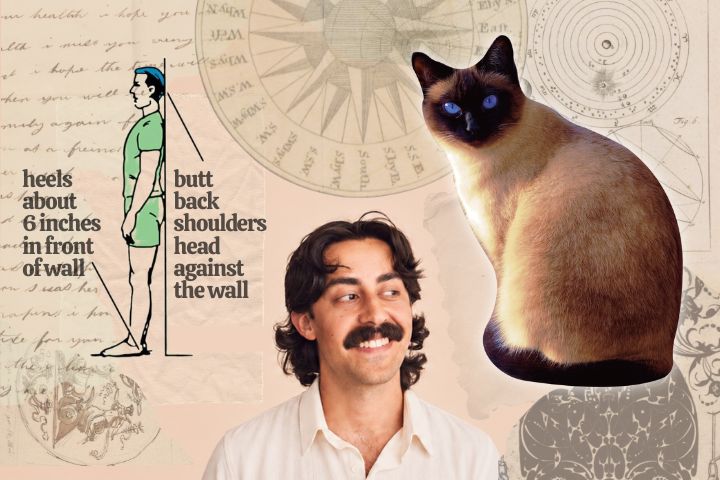
One of the problems with the way posture is discussed online is that it is often treated as a static photograph. Someone stands sideways. A line is drawn through their ear, shoulder, hip, knee and ankle. Their head is slightly forward.Their pelvis is slightly tilted. Their shoulders are slightly rounded. And suddenly we have a list of things that supposedly need to be fixed. But humans do not live as photographs. We move. We sit. We stand. We walk. We run. We lift. We lean. We rotate. We change positions hundreds or thousands of times throughout the day.
Perhaps a more useful concept is not perfect posture, but postural variability and capacity. Recent research is beginning to look at this more directly. A 2025 prospective study examining lumbar posture during daily life found that individuals with chronic low back pain displayed fewer main lumbar postures across a 24 hour period than asymptomatic individuals. The difference was statistically significant, although the effect size was small.
This is interesting because it shifts the conversation away from identifying one “bad” posture and towards asking whether someone is becoming restricted to a smaller range of comfortable movement and positions.
So, How Much Should You Care About Your Posture?
My answer is probably different from what you would expect. If changing your posture makes you feel better, move more comfortably or tolerate an activity you previously struggled with, then absolutely use it. There is nothing wrong with finding positions that feel good. But I would be cautious about turning posture correction into a lifelong project.
If you are spending a significant amount of time every day thinking about whether your head is forward, whether your shoulders are rounded, whether your pelvis is tilted or whether your spine is perfectly aligned, I think it is worth asking what that effort is actually achieving. Is your capacity increasing? Are your symptoms decreasing? Are you becoming more confident in movement? Are you doing more of the activities you enjoy? Or are you simply becoming better at monitoring and correcting your posture?
Those are very different outcomes.
The Question I Keep Coming Back To
If posture correction helps you, that's great.
But sometimes it is worth asking: If I have to keep doing this forever, how do I know it was actually the root cause? Is there an endpoint? Is there a point at which you can stop thinking about your posture and simply focus on the exercise, sport, work or activities that you actually enjoy?
I think there should be. And perhaps that is ultimately the most useful way to think about posture. Not as something that needs to be perfected, but as one of many factors that can influence how a person experiences movement and symptoms. For some people, changing posture may be an important part of the process. For others, it may make very little difference.
For someone with persistent pain, it may influence symptoms without being the mechanism that originally created them. And for some people, relentlessly trying to correct a posture that their body has adapted to may simply become another source of restriction.
The research does not give us a simple answer, and neither does clinical outcomes. But perhaps that is the point. Pain is rarely as simple as a photograph of someone's posture.
My goal is not to convince people that posture does not matter. It is to help people understand when it matters, how it might matter, and when it may be time to stop trying to fix it. Because ultimately, I don't want someone to spend the rest of their life trying to sit perfectly. I want them to be able to sit, stand, exercise, play sport, work and move without constantly worrying that they are doing something wrong. If we can get to a point where posture correction becomes a tool rather than a lifelong obligation, I think we have achieved something much more valuable than simply making someone look straighter.